Punta Cana Condos for Sale: Read the Paperwork Before the Photograph
A search for Punta Cana condos for sale returns the same three things over and over: a photograph, a floor area, and a price. Those are the easiest facts to publish and the least useful for deciding anything, because none of them describes what the title will say you own, or what a week actually looks like from the front door. This page answers the search from inside one address — our own, Puerto Marina in Cap Cana — and it is written in the order buyers usually wish they had used: the paperwork first, the photograph last.
“Punta Cana” on a listing is a region, not an address
The phrase covers a long run of coast and a number of separately gated communities, each with its own roads, its own security arrangement and its own association. Two condos advertised under the same three words can therefore sit twenty minutes and one very different daily routine apart. The quickest way to cut through that is to make every listing convert its adjectives into drive times, and then to judge the times rather than the adjectives.
Ours convert like this. From the building, the marina village is about a 3-minute drive, Juanillo Beach about 4, Scape Park about 8, and Punta Cana International Airport about 20; the sea sits 660 ft away. Whether that particular set of numbers suits the way you would use a second home is a matter of taste, and taste is allowed. What is not optional is having numbers at all: a listing that answers “close to everything” has told you nothing you can weigh against the next one.
What is legally for sale is a unit plus a share of everything around it
A condominium is not a smaller house. It is a legal object with two halves, and a Dominican title describes both. On its own, a building is one property; it turns into many individually owned homes only when a condominium regime is entered at the Registro de Títulos, and that entry is what sets out which parts belong to a single owner, gives each of them its own way in and out, and leaves the rest common to everybody. The governing statute is the Condominium Law, Ley 5038 of 1958, read today alongside the Real Estate Registry Law 108-05 of 2005.
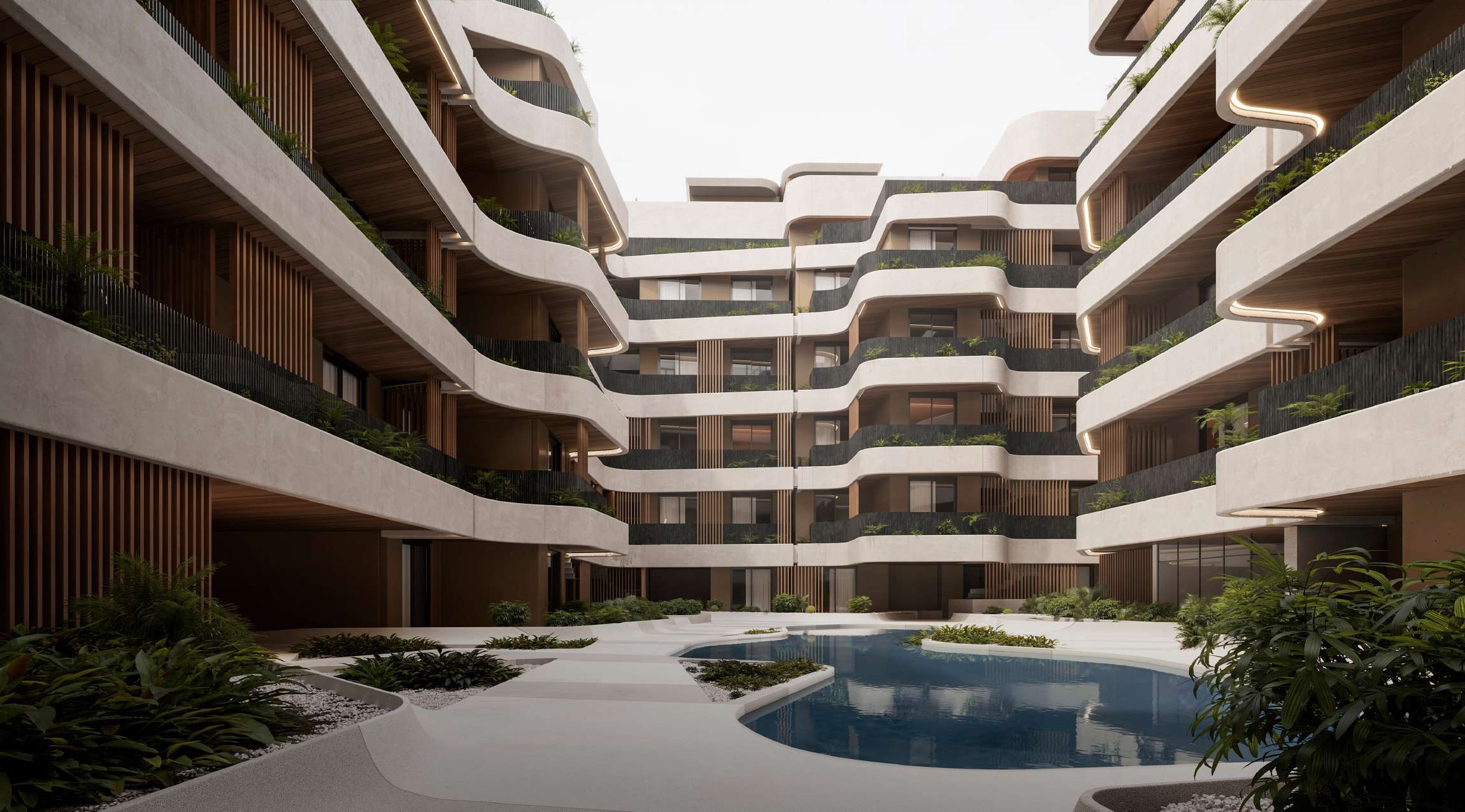
Which is why the courtyard in the picture matters as much as the kitchen. Your deed will describe an apartment, and it will also hand you an undivided share of the ground under it, the circulation, the pools and the roof — assets you cannot sell separately and cannot opt out of maintaining. Nationality changes none of this: a foreign buyer takes the same registered right, on the same terms, as a Dominican one, and there is no presidential approval to obtain, that requirement having been abolished in 1998 after dating from 1945. For a building still going up, the registry also publishes a route for a regime that is in process; where any particular project stands inside that route is a question for a Dominican attorney rather than for a listing page.
Most of what is for sale here is not standing yet, so you are comparing documents
Ours is not standing yet either: Puerto Marina is 97 residences with delivery scheduled for 2029. That is not a drawback to be argued away, but it does change what the comparison is made of. You are not choosing between rooms you have walked through; you are choosing between undertakings, and an undertaking is only as good as the sentence it is written in.
Three documents carry most of that weight. The first is whatever fixes the floor area — ask which surface the figure measures, and whether terraces and plunge pools are counted inside it or outside, because two buildings quoting the same number on different bases are not quoting the same home. The second is the specification: finishes, appliances and equipment named in writing rather than implied by a render. The third is the contract's own language about the date — what is undertaken, and what applies if that date moves. A listing is allowed to be vague about all three. A contract is not, and the contract is the thing you are actually buying.
Inside one building, the price ladder tells you what the design treated as scarce
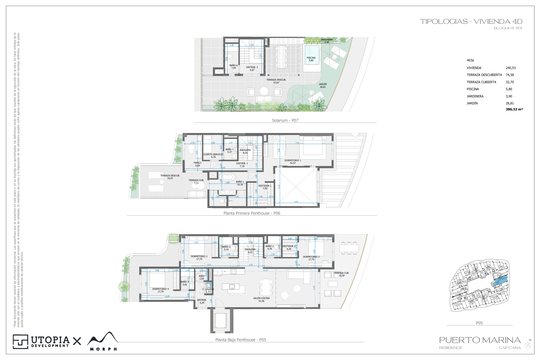
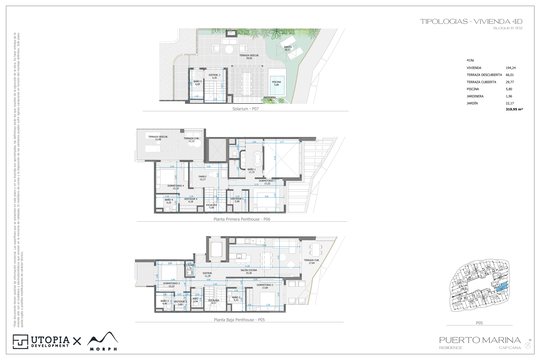
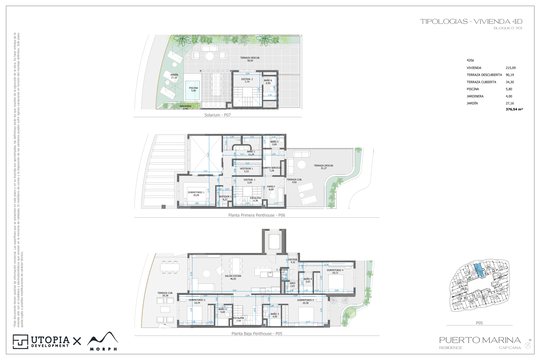
Between developments a price comparison is mostly noise, because the two homes are rarely the same product. Within one building it becomes informative. At Puerto Marina the published entry point is the mid $500,000s: two-bedroom residences with a garden or ocean outlook begin at $555,000, three-bedroom lake residences at $695,000, and the four-bedroom penthouses, which run over three levels, at $1,175,000. The largest plans in the catalogue are the four-bedroom duplexes, between 2,088 sq ft and 2,583 sq ft.
Read a ladder like that as information about the building rather than about the market. It shows you which outlooks the design treated as scarce, how much outdoor space is attached at each tier, and where the jumps sit — which is the conversation worth having before any single photograph does your deciding for you.
| Residence type | Bedrooms | Published starting price |
|---|---|---|
| Garden and ocean-outlook residences | 2 | $555,000 |
| Lake residences | 3 | $695,000 |
| Penthouse over three levels | 4 | $1,175,000 |
A tax status is a filing, not a feature of the building
Nearly every new development on this coast advertises one word, CONFOTUR, and it is worth knowing exactly what sits behind it. Law 158-01, passed in 2001 and amended by Law 195-13 in 2013, lets approved tourism projects pass two specific reliefs to their buyers: the 3% property-transfer tax, and the 1% IPI — the annual property tax, which in any case is charged only on value above a threshold the tax authority adjusts each year. The relief runs 15 years, and the clock starts at completion of construction rather than at signature.
Two conditions do the real work. It reaches first buyers from the developer, so a resale sits outside it; and it is not automatic, but has to be filed and recorded against the title. That turns the useful question at a viewing into a documentary one rather than a promotional one: has the resolution been issued for this project, and what is recorded against the title you would be taking? Puerto Marina is CONFOTUR-approved, with its exemption published as 15 years. How the relief lands in your own purchase, and how rental earnings are assessed alongside it, are questions for a Dominican attorney.
Six things to ask for, and what the answers tell you
None of this needs a specialist to read. It needs six requests and a careful look at whatever comes back. The registry description of the unit itself. The regime's bylaws, with the list of what counts as a common part. The basis on which the floor area is stated. The contract's undertaking about the delivery date. The CONFOTUR resolution for the project. And what the common parts cost to run, with how that cost is divided between owners.
Nothing on that list is exotic, and none of it is a negotiation — it is paperwork that already exists for any development worth buying into. The answers are informative twice over. Where they arrive quickly and in writing, you have learned something about the building; where they arrive as an adjective, you have learned something about the seller. Each of those six exists for Puerto Marina and can be read before anything is signed, and the strictly legal reading of them belongs with a Dominican attorney.
Common questions
- Can a foreign buyer own a condo in Punta Cana outright?
- Yes. A foreign national takes the same registered ownership right, on the same terms, as a Dominican national; there is no nationality restriction and no approval step to clear, the old requirement for presidential approval having been abolished in 1998. What that does not settle is your particular transaction — the structure you buy through, the searches your lawyer runs and the closing itself are specific to you, and belong with a Dominican attorney.
- What does “from the mid $500,000s” actually get you at Puerto Marina?
- It is the entry point of a published ladder rather than an average. Two-bedroom residences with a garden or ocean outlook start at $555,000, three-bedroom lake residences at $695,000, and the four-bedroom penthouses over three levels at $1,175,000. What moves a residence up that ladder is where it sits in the building, how much of it is outdoors, and how much floor area it carries — the four-bedroom duplex plans run from 2,088 sq ft to 2,583 sq ft.
- Is a CONFOTUR condo tax-free?
- It is exempt from two named taxes, which is a narrower claim and a more useful one. Law 158-01 lets an approved project pass the 3% property-transfer tax and the 1% annual IPI to its first buyers from the developer, for 15 years counted from completion of construction, and only where the benefit has been filed and recorded against the title. Rental earnings are assessed under their own rules; how both apply to you is a question for a Dominican attorney.
- Is it better to buy a finished condo than one still being built?
- They are different purchases, and the honest answer turns on what you can verify. A finished home can be walked through, which settles a great many questions in an afternoon. A pre-construction one — Puerto Marina delivers in 2029 — is settled instead by documents: the floor-area basis, the written specification, the delivery undertaking and the registry position. If those read clearly, you know what you are getting; if they do not, no render will fix it.
Want the details for your own situation?
Ask about availability, layouts or the buying process, and someone from the sales team will get back to you.
Get in touch