Apartments for Sale in Punta Cana, Dominican Republic: Which Water Are You Actually Buying?
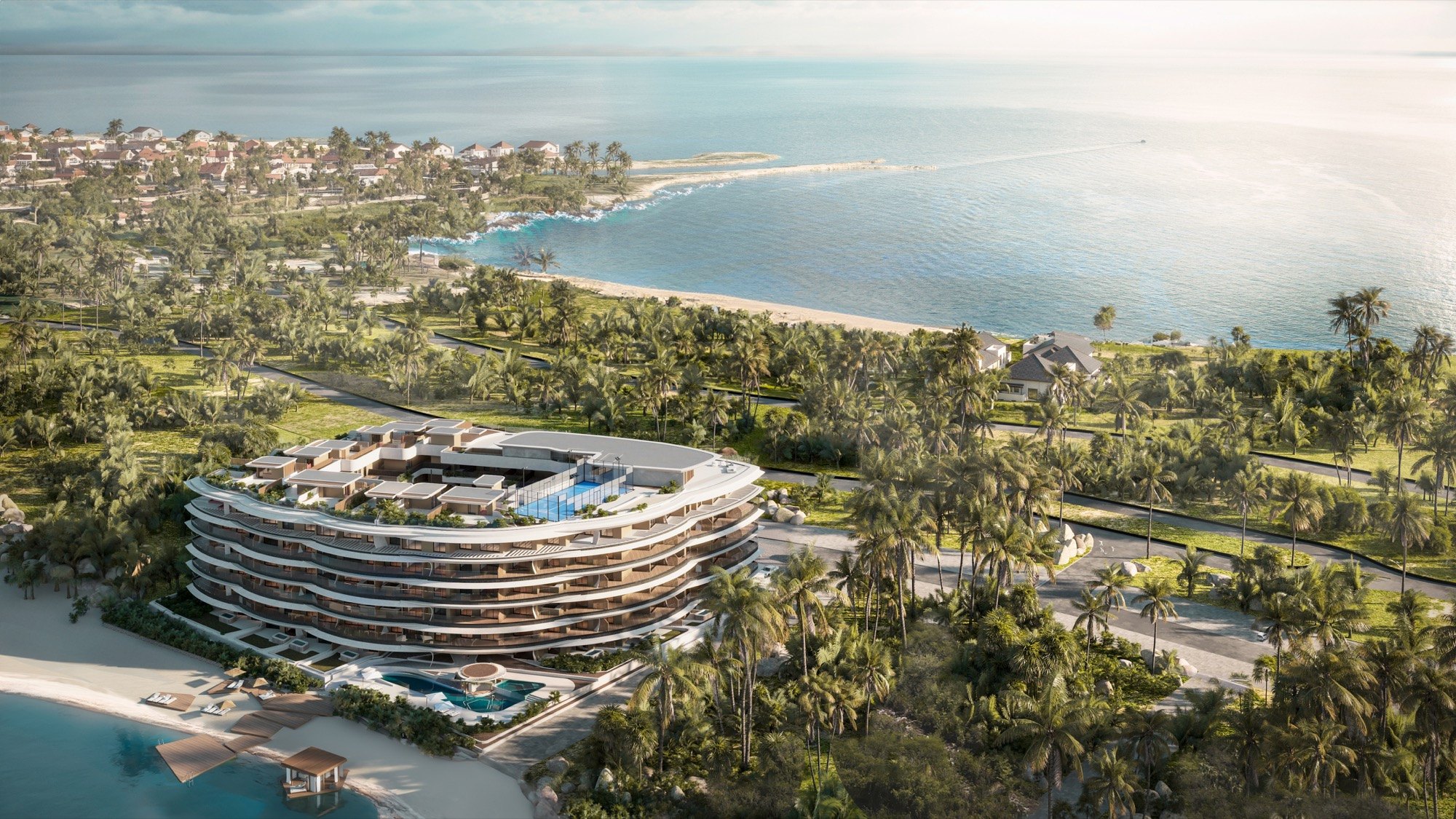
Almost every apartment for sale in Punta Cana is sold on water, and the words doing that work — waterfront, ocean view, lakeside, marina living — cover at least four relationships that behave nothing like each other once you live with them. This page separates them, from the address we know best: Puerto Marina stands inside Cap Cana between Blue Lake and the sea, with 660 ft between its own lake beach and the shoreline. It names no other development and prices none. These are simply the questions we would want a buyer to put to our drawings, and to anybody else's.
Four different waters, one word
Read twenty listings for apartments in this part of the Dominican Republic and you will read the word water twenty times, doing four completely different jobs. There is the sea. There is a marina basin, which is water as a place rather than water as a swim. There is inland water — a lake or a lagoon, flat and sheltered, looking onto the community rather than onto the horizon. And there is the water a building keeps itself: the pools, which are the water most owners are in most often.
Photography flattens all four into the same blue rectangle, and a floor plan will not tell them apart either. What separates them is prosaic and entirely knowable: how far the water is in feet, whether the route to it stays inside the gate, who is allowed to use it, who maintains it, and what the law says about who owns it. This page takes those questions in order. It is written from one building rather than about a market, so it lists nothing and compares nobody.
A waterfront claim is a distance and a route, not an adjective
Distances are checkable, and adjectives are not. Ask for the number of feet from the building to each body of water, then ask what lies between the two. At Puerto Marina the sea is 660 ft from the building; Juanillo Beach is about a 4-minute drive, and the marina village about 3. Those are ordinary figures and any development can produce their equivalent when asked. The ones that answer with an adjective instead are telling you something.
Then separate the three verbs, because they come apart more often than buyers expect. A view is a compass fact: it depends on which way the terrace faces and what stands between you and the water, and it can be excellent from a building nobody would call walkable. Access is a route — whether it stays inside a gated community or crosses a public road, whether it is paved, lit and shaded, and whether you would send a child along it alone. Use is a habit: the water you actually get into, as opposed to the water you look at. Puerto Marina is pre-construction, with delivery scheduled for 2029, so today every one of these distances is read off a site plan — which is all the more reason to ask for the number rather than the adjective.
No building in the Dominican Republic owns a beach
Before a brochure says anything, the law has already settled the question of ownership. The Dominican Constitution places the country's beaches and coasts — along with its rivers, lakes and lagoons — in the public domain and guarantees free access to them, while respecting private property rights on the land behind. A strip along the shoreline is held as a public easement. No tourism project buys the sand, and none can lawfully shut the public out of it.
So when a listing says private beach, it is describing a service rather than a title. What can genuinely be private is the facility around the water: the furniture and the shade, the path down to it, the gate you pass through on the way, and the standard to which somebody keeps it. That is worth a great deal, and it is worth naming precisely. Ask who maintains the beach facility, ask who may use it — owners, their guests, a visitor renting for a week — and ask whether that answer lives in the condominium documents or only in the sales material. At Puerto Marina the private lake beach on Blue Lake is a facility of the development; the sea beyond it is public, exactly as every beach in the country is.
A lake is not a smaller sea
Inland water is the category buyers most often picture wrongly, because they picture a miniature ocean. It does not behave like one. A lake or a lagoon is flat: there is no surf to time and no shorebreak to explain to a child, and a swim becomes an unhurried thing rather than an event. It also faces the other way, in the sense that matters — the far shore is part of the community, so the outlook is of a place rather than of distance.
None of that is a defect. It is a different product, and for a good number of owners it is the better one; a calm sheltered beach is the one small children are taken to and the one that gets used on a weekday morning. What it should never be is a substitute presented as the same thing. If a listing offers you water, establish which of the two it means and whether the other is also within reach. Both are published here: a private lake beach on Blue Lake, and the sea 660 ft away. The useful test is not which sounds better in a headline, but which one you would walk to on an ordinary Tuesday.
A marina is water you go to, not water you swim in
The third kind of water is the one least likely to involve swimming at all. A working basin is a destination: boats coming and going, a quay to walk along, somewhere to eat, an errand to run at the end of it. From Puerto Marina the marina village is about a 3-minute drive. As an amenity it behaves more like a town square than like a beach, which is precisely why it suits some buyers and not others — it is sociable, it has traffic, and it is busiest exactly when the sea is quietest.
One thing about marina addresses is worth settling in writing rather than assuming. An apartment at a marina does not come with a berth. Mooring is a separate arrangement with whoever operates the basin, on its own terms and its own waiting list, and nothing published for these residences attaches a slip or a mooring right to a home. If a boat is part of the reason you are buying, make that a written question early — to us and to anyone else you are talking to — rather than a hope you test after closing.
The water the building keeps is the water you use most
Then there is the water nobody puts in the headline, and it is the water an owner is in most often: the building's own. Puerto Marina publishes three ways to swim across 97 residences — the private lake beach on Blue Lake, a beachfront infinity pool and a rooftop panoramic infinity pool.
They are not interchangeable, and the difference is mostly time of day. A rooftop pool is an evening and late-afternoon room: exposed, quiet, and at its best once the heat has gone out of the day. A pool at ground level is where a family spends a whole morning, because the shade is nearer and so are the bags, the towels and everything else. A beach, lake or sea, is where people go when they want the day to feel unstructured. So ask how many swimming options a building has, where the sun sits on each through the day, how many homes share them, and which one families end up at. Those four answers will describe your summers better than any photograph of blue water.
Six questions that settle 'waterfront' faster than any photograph
None of these needs a lawyer to ask, and the answers separate two apartments faster than a price list does.
- How many feet from the building to each body of water — and is that a straight line on a plan or a walk you can take?
- Does the route stay inside the gate, and is it paved, lit and shaded?
- Who may use the beach facility — owners, their guests, a visitor renting for a week — and where is that written down?
- Who maintains it, and how does that obligation appear in the condominium documents?
- Is a mooring included? Assume it is not until a document says otherwise.
- Which water would you use on a Tuesday? Answer that honestly and most of the marketing vocabulary stops mattering.
Common questions
- Does a 'private beach' mean the beach belongs to the development?
- No. The Dominican Constitution places beaches, coasts, rivers, lakes and lagoons in the public domain with free access, and a strip along the shoreline is held as a public easement, so no development holds title to sand at the sea. What a development can offer is the facility and the route to it: the furniture, the shade, the path, the gate and the upkeep. Read the phrase as a description of service, then ask who may use it and where that is written.
- How far is the sea from an apartment at Puerto Marina?
- The figure we publish is 660 ft between the private lake beach on Blue Lake and the sea. Juanillo Beach is about a 4-minute drive and the marina village about 3. The building is pre-construction with delivery scheduled for 2029, so these are site-plan distances rather than a walk anyone can take today, and no walking time from a particular front door is published.
- What is the practical difference between a lake beach and a sea beach?
- Flat water against moving water, mostly. A lake has no surf and no shorebreak, which makes it the calmer option for small children and for a swim nobody planned; its outlook is the community on the far shore rather than an open horizon. The sea gives you breeze, sound and distance. Neither substitutes for the other, which is why it is worth establishing whether a building offers one, the other, or both.
- If I buy an apartment at a marina development, do I get a mooring for a boat?
- Not automatically, and it should never be assumed. Mooring is a separate arrangement with the operator of the basin, on its own terms, and nothing published for these residences attaches a berth or a slip to a home. If a boat is part of the plan, put the question in writing before you go any further.
Want the details for your own situation?
Ask about availability, layouts or the buying process, and someone from the sales team will get back to you.
Get in touch